How Do Flat Face Hydraulic Couplers Work?
- Share
- Issue Time
- Jun 29,2026
Summary
Flat face hydraulic couplers (ISO 16028) use a push-to-connect, double shut-off valve design with flush mating surfaces to create a leak-free, contamination-resistant connection.
How Do Flat Face Hydraulic Couplers Work?
Understanding the Engineering Behind Leak-Free Hydraulic Connections
Flat face hydraulic couplers are the industry standard for clean, safe, and efficient hydraulic connections. Unlike traditional ball-lock or poppet-style couplers, flat face designs feature a flush, smooth mating surface that seals completely when disconnected, virtually eliminating fluid spillage and contamination. Compliant with the ISO 16028 international standard, these couplers have become the preferred choice across construction, agriculture, industrial automation, and heavy machinery sectors worldwide. But how exactly do they work, and why are they replacing conventional coupling designs?
What Are Flat Face Hydraulic Couplers?
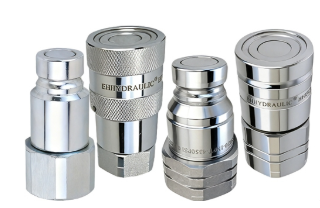
A flat face hydraulic coupler is a type of quick-connect hydraulic fitting designed to join two hydraulic lines—such as hoses, pipes, or machine components—through a flat, flush mating surface. Each coupler consists of a male (plug) and female (socket) half, both equipped with internal shut-off valves and precision-machined flat faces. When the two halves are disconnected, each end seals independently, preventing hydraulic fluid from escaping and blocking contaminants from entering the system.
The defining characteristic of flat face couplers is their ISO 16028 compliance, an international standard that ensures dimensional interchangeability across major global manufacturers including Ehhydraulic,Stucchi, Parker, Eaton, Faster, and Holmbury. This means you can confidently mix and match couplers from different brands without compromising performance or safety.
How Do Flat Face Hydraulic Couplers Work?
The operating principle of flat face hydraulic couplers is elegantly simple yet highly effective. It all comes down to the sequence of events during connection and disconnection, and the ingenious design of the internal valve system.
The Core Mechanism: Flat Face Valve Technology
At the heart of every flat face coupler lies a flat-face valve element housed within both the male and female halves. These valves are spring-loaded and normally closed—meaning they automatically seal the fluid passage when no force is applied. The magic happens in the precise sequence of contact, sealing, and flow activation.
Connection Process: Step by Step
- Initial Contact: The flat face of the male half is pushed into the female body. The two flat metal surfaces make contact first, creating an immediate external seal before any internal valves open.
- Valve Retraction: As the connection deepens, the male half pushes against the female valve element, simultaneously retracting both internal valves from their seats. This synchronized movement ensures that the fluid passage opens only after the outer seal is already in place.
- Flow Path Opens: With both valves retracted, hydraulic fluid can flow freely through the coupling. The flat face design minimizes flow restriction, delivering up to 70% higher flow rates than traditional poppet-type couplers.
- Locking Engagement: A sleeve-lock or threaded mechanism secures the connection, preventing accidental disconnection even under high vibration or heavy mechanical stress.
Disconnection Process: Step by Step
- Unlock the Sleeve: The operator pulls back the female sleeve (or unscrews the locking nut in threaded designs), releasing the mechanical lock.
- Valves Close First: As the halves begin to separate, the internal valve elements extend back to their seats before the flat faces fully separate. This is the critical sequence that traps residual fluid inside the coupler.
- Clean Separation: The flat faces part cleanly with virtually no fluid spillage and no cavity exposed to the environment, preventing dirt and debris from entering the system.
Flat Face vs. Standard Hydraulic Couplers: What's the Difference?
To truly understand the value of flat face couplers, it's important to compare them with the traditional alternatives that dominated the industry for decades.
| Feature | Flat Face (ISO 16028) | Standard / Poppet Style | Ball-Lock Type |
|---|---|---|---|
| Fluid Spillage | Near Zero (0.02–0.1 mL) | High | Moderate to High |
| Contamination Risk | Minimal – flat surface easy to wipe clean | High – cavity traps dirt and debris | Moderate – ball chamber can accumulate contaminants |
| Connection Under Pressure | Yes – up to 100 bar (1450 PSI) residual pressure | Difficult / Impossible | Limited |
| Pressure Rating | Up to 420 bar (6100 PSI) | 250–315 bar typical | 250–315 bar typical |
| Air Ingress | Minimal – seals before valves open | Common – leads to cavitation | Possible during connection |
| Vibration Resistance | Excellent – threaded or sleeve lock | Fair | Poor – balls can indent and seize |
| Flow Efficiency | High – low pressure drop | Moderate | Moderate |
| Cost | Higher upfront | Lower | Moderate |
While standard poppet-style and ball-lock couplers may have a lower initial cost, the long-term expenses associated with fluid loss, contamination-related failures, and increased maintenance quickly offset any upfront savings. Flat face couplers are an investment that pays for itself through reduced downtime and extended component life.
Key Benefits of Flat Face Hydraulic Couplers
1. Near-Zero Spillage and Environmental Compliance
Flat face couplers are designed to contain hydraulic fluid within the system at all times. With residual oil spillage of just 0.02–0.1 mL per disconnect, these couplers help operations meet strict environmental regulations and workplace safety standards. This is particularly critical in indoor facilities, food processing environments, and ecologically sensitive areas where even a small oil leak can have serious consequences.
2. Superior Contamination Prevention
The flat mating surface has no cavities or recesses where dirt, dust, water, or metal debris can accumulate. Before connection, the flat faces can be quickly wiped clean—a simple but highly effective contamination control measure. By preventing contaminants from entering the hydraulic system, flat face couplers protect expensive components such as pumps, valves, cylinders, and motors, significantly extending their service life and reducing unplanned maintenance.
3. Connection Under Residual Pressure
Many flat face coupler designs allow safe manual connection even when residual pressure of up to 100 bar (1450 PSI) is trapped on the male half. This eliminates the need for pressure relief tools or time-consuming system depressurization, enabling faster attachment changes and improving overall jobsite productivity.
4. Exceptional Durability and Vibration Resistance
Constructed from high-strength carbon steel or stainless steel with zinc-nickel plating, flat face couplers are built to withstand the harshest operating conditions. Threaded locking mechanisms eliminate the brinelling damage (surface indentation) associated with ball-lock designs, while anti-loosening structures prevent accidental disconnection under severe vibration. Quality units are rated for over 100,000 impulse cycles and 25,000 connect-disconnect cycles without leakage or structural failure.
5. Global Interchangeability
Compliance with ISO 16028 ensures that flat face couplers from different manufacturers are dimensionally interchangeable. Whether you're using Ehhydraulic ,Stucchi, Parker, Eaton, Faster, or any other major brand, you can confidently connect and disconnect across brands without compatibility concerns—a crucial advantage for global operations and equipment rental fleets.
Where Are Flat Face Hydraulic Couplers Used?
Flat face couplers have become the standard across a wide range of industries and applications where cleanliness, reliability, and high-pressure performance are essential:
Typical Technical Specifications
| Parameter | Typical Range |
|---|---|
| Standard | ISO 16028 |
| Working Pressure | Up to 420 bar (6100 PSI) |
| Burst Pressure | Over 1000 bar (14,500 PSI) |
| Size Range | 1/4" to 1-1/4" (6.3mm to 32mm) |
| Temperature Range | -40°C to +150°C (depending on seal material) |
| Seal Materials | NBR, FKM (Viton), EPDM, PTFE |
| Body Materials | Carbon Steel, Stainless Steel |
| Surface Finish | Zinc-Plated, Zinc-Nickel, Chrome III |
| Spillage per Disconnect | 0.02–0.1 mL |
| Service Life | 100,000+ impulse cycles / 25,000+ connect-disconnect cycles |
Frequently Asked Questions
The Bottom Line
Flat face hydraulic couplers represent a fundamental advancement in hydraulic connection technology. Their ingenious flat-face valve design—sealing before opening, and closing before disconnecting—solves the age-old problems of fluid spillage, contamination, and connection difficulty that have long plagued hydraulic systems. With compliance to the ISO 16028 standard ensuring global interchangeability, and proven performance in the world's most demanding applications, flat face couplers have rightfully earned their place as the new baseline engineering standard. Whether you're operating excavators on a construction site, swapping implements on a farm tractor, or running precision hydraulic automation in a factory, flat face couplers deliver the clean, safe, and reliable performance your operation demands.