How to Identify NPT Thread and Other Hydraulic Fitting Types
- Share
- Issue Time
- May 18,2026
Summary
To accurately identify hydraulic fittings, it is necessary to combine observation (taper degree, sealing type), measurement (diameter, pitch) and verification (markings, equipment origin). The most reliable method is to take measurements with a thread gauge and vernier caliper, and make final confirmation by referring to authoritative standard dimension tables for threads.
How to Identify NPT Thread and Other Hydraulic Fitting Types?
Hydraulic systems are the lifeblood of countless industrial applications, from agriculture and construction to aerospace and manufacturing. At the heart of these systems are hydraulic fittings and adapters, which ensure leak-free connections and reliable performance. However, with a myriad of thread types and standards used globally, correctly identifying hydraulic fittings becomes a critical skill for operators, maintenance technicians, and engineers. Using the wrong fitting can lead to leaks, system failures, equipment damage, and even safety hazards . This comprehensive guide will walk you through the essential steps and knowledge needed to accurately identify NPT threads and other common hydraulic fitting types, ensuring compatibility, safety, and optimal system performance.
Why Hydraulic Thread Identification is Critical
Hydraulic threads may look similar at first glance, but subtle differences in taper, pitch, thread angle, and sealing method define their compatibility and function. Misidentification can have catastrophic consequences, including:
- Leaks and System Failure: Incompatible threads cannot form a proper seal, leading to fluid leaks, pressure loss, and system malfunction .
- Thread Damage: Forcing mismatched threads together can strip or gall the threads, damaging both the fitting and the port, resulting in costly repairs .
- Compromised Safety: Hydraulic systems operate under high pressure. A failed connection can release high-pressure fluid, posing a serious risk to personnel .
- Downtime and Productivity Loss: Incorrect part replacement leads to repeated maintenance, extended downtime, and lost revenue .
Therefore, mastering thread identification is not just a technical skill—it's a fundamental requirement for safe, productive, and profitable operations .
Most Common Types of Hydraulic Threads
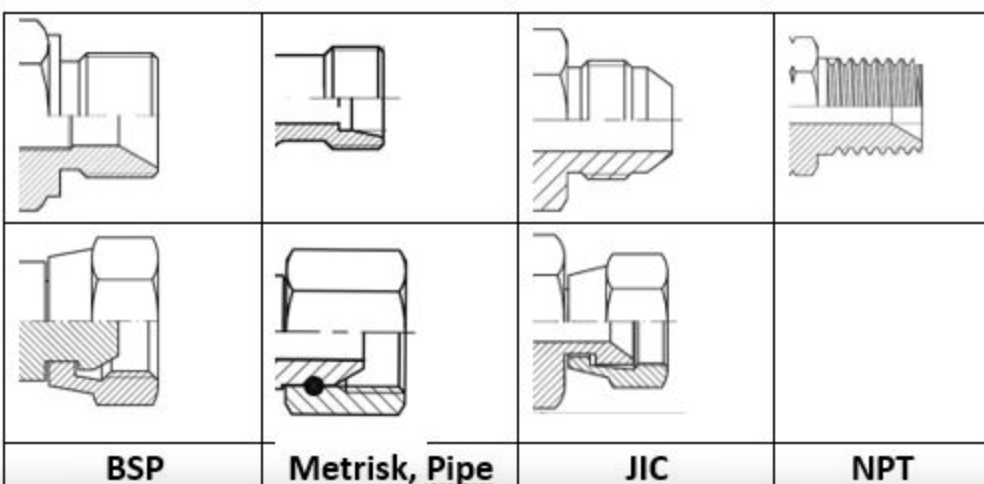
Understanding the key characteristics of each thread type is the first step in identification. Here are the most prevalent hydraulic fitting threads used worldwide :
- NPT (National Pipe Tapered): The dominant standard in North America. NPT threads are tapered with a 60-degree thread angle and a 1:16 taper rate . They create a metal-to-metal seal that typically requires thread sealant (e.g., Teflon tape or pipe dope) for a leak-free connection. Once disconnected, they often leak upon reconnection, so they are not designed for frequent make-and-break cycles .
- SAE / ORB (O-Ring Boss): Features a straight (parallel) thread with a visible O-ring seated at the base of the male thread. The seal is achieved by the O-ring compressing against a machined shoulder in the female port, offering excellent, reusable sealing . The thread form is the same as JIC 37° flare, but the sealing mechanism differs.
- BSPP (British Standard Pipe Parallel / "G" Thread): A straight thread standard common in Europe, Asia, and other regions. It requires a separate bonded washer or Dowty seal to create a seal, as the threads themselves do not provide sealing .
- JIC (Joint Industrial Council / 37° Flare): Characterized by a 37-degree flared seating surface on both male and female fittings. The seal is formed by metal-to-metal contact between the flare and the cone seat. It is common in high-pressure fluid power systems and can be disconnected and reconnected, though overtightening can cause cracking .
- ORFS (O-Ring Face Seal): Identified by an O-ring located in a groove on the flat face of the male fitting. This O-ring seals against a flat surface on the female fitting. It uses straight threads and provides a highly reliable, reusable seal that is not dependent on thread tightness .
- BSPT (British Standard Pipe Tapered / "R" Thread): The tapered version of the British standard. Like NPT, it is tapered but has a 55-degree thread angle, making it incompatible with NPT .
- Metric Parallel & Tapered: Common in Europe and on equipment following ISO/DIN standards. They are identified by their metric dimensions (e.g., M14x1.5). Metric tapered threads are often designated with a "keg" or "Taper" suffix .
Step-by-Step Guide to Identifying Hydraulic Fitting Threads
Follow this systematic, four-step process to accurately identify any hydraulic fitting thread .
-
Step 1: Determine the Coupler Gender and Basic Design
First, identify whether the fitting is male (external threads, sometimes called a nipple or plug) or female (internal threads) . Next, perform a visual inspection for obvious sealing features:
- Is there a visible O-ring at the base of the male thread? This indicates an SAE/ORB fitting .
- Is there an O-ring on a flat face of the male thread? This indicates an ORFS fitting .
- Is there a 37-degree flared cone at the end? This indicates a JIC fitting .
- Does the fitting have a tapered appearance without an O-ring or flare? This suggests NPT, BSPT, or Metric Taper .
-
Step 2: Determine if the Thread is Tapered or Parallel
This is a crucial distinction. Tapered threads (NPT, NPTF, BSPT) decrease in diameter along their length. Parallel threads (SAE/ORB, BSPP, ORFS, Metric Parallel) maintain a constant diameter .
How to Check: Visually inspect the thread. If the diameter visibly reduces towards the end, it is tapered. If unsure, use calipers to measure the major diameter at both ends of the threaded section. A difference indicates a taper . The presence of an O-ring almost always confirms a parallel thread design .
-
Step 3: Measure the Thread Pitch
Thread pitch is the distance between adjacent thread crests. For imperial threads (NPT, SAE, JIC, etc.), it is measured as Threads Per Inch (TPI). For metric and BSP threads, it is measured as the distance in millimeters (mm) between threads .
How to Measure: Use a thread pitch gauge. Match the gauge's teeth to the threads. For TPI, count how many thread crests fit within one inch using a ruler or caliper. Accurate pitch measurement is vital, as different thread standards have distinct pitches .
-
Step 4: Determine the Thread Size
Size determination depends on whether the thread is a pipe thread or a non-pipe (straight) thread.
- For Pipe Threads (NPT, BSPT, BSPP): Size is denoted by a nominal pipe size, not the actual diameter. A common method is to measure the outer diameter (OD) of the male thread with calipers and subtract 1/4 inch (for NPT) to approximate the nominal size . Refer to a standard thread size chart for confirmation (e.g., 1/2" NPT has an approximate OD of 0.840 inches) .
- For Non-Pipe Threads (SAE, Metric, JIC): Measure the actual major diameter (OD for male, inner diameter for female) with calipers. For dash-sized fittings (e.g., -8), remember that the dash size refers to the hose/tube ID, not the thread size .
-
Step 5: Combine Findings to Identify the Thread Type
Cross-reference your observations from the previous steps using a hydraulic thread identification chart or table . For example:
- Tapered + 60° angle + measured TPI & size matching NPT chart = NPT.
- Parallel + O-ring at base + measured TPI & size = SAE/ORB.
- Parallel + 37° flare + measured TPI & size = JIC.
- Parallel + No O-ring/Flare + requires bonded washer + measured pitch (mm) = BSPP.
Consulting manufacturer catalogs or online resources from reputable suppliers like Ehhydraulic can provide definitive charts for comparison .
Essential Tools for Accurate Identification
Having the right tools makes identification faster and more reliable:
- Calipers (Digital or Vernier): For precise measurement of thread diameter and checking for taper .
- Thread Pitch Gauge: The most accurate tool for determining TPI or metric pitch .
- Thread Identification Chart/App: A quick reference to match measurements to thread standards .
- Good Lighting and Magnification: Helps inspect thread profile and small features like O-ring grooves.
- Sample Fittings or Thread Plug/Gauge Set: For direct visual and physical comparison.
Common Mistakes and How to Avoid Them
Even experienced professionals can make errors. Be aware of these pitfalls:
- Mixing NPT and BSPT/BSPP: They are not interchangeable. NPT has a 60° angle, while BSP threads have a 55° angle. Forcing them together will damage threads and cause leaks .
- Confusing Dash Size with Thread Size: A -8 hose fitting does not necessarily have a 1/2" thread. Always measure the thread itself .
- Assuming Tapered Threads are Always NPT: BSPT and Metric Taper also exist. Check the pitch and angle.
- Over-tightening Tapered Threads: NPT and BSPT seal by wedge action, not extreme torque. Over-tightening can crack fittings or ports, especially in softer materials .
- Neglecting to Use Sealant on NPT: Despite the metal-to-metal interference, NPT threads generally require a sealant to fill microscopic spiral leak paths .
- Reusing NPT Connections Without Fresh Sealant: Disassembling an NPT joint breaks the seal. Reconnection without new sealant will likely leak .
Conclusion
Accurately identifying NPT and other hydraulic fitting threads is a fundamental skill that ensures system integrity, safety, and efficiency. By following a logical process—inspecting sealing features, determining taper, measuring pitch and size, and consulting reference charts—you can confidently select the correct replacement parts. Remember that when in doubt, consult technical documentation, use the proper tools, and when possible, cross-reference with known components or seek advice from hydraulic specialists. Investing time in correct identification prevents costly downtime, repairs, and potential safety incidents, keeping your hydraulic systems running smoothly and reliably .
References & Further Reading
- Ehhydraulic. "How to Identify NPT Thread and Other Hydraulic Fitting Types." Ehhydraulic Blog.
- DF Hydraulics. "Hydraulic Thread Identification: How to Identify Hydraulic Threads."
- Rubber & Specialties. "How to Identify NPT, JIC & Hydraulic Hose Fitting Threads."
- TITAN Fluid. "What Are NPT Fittings? Complete Engineering Guide to National Pipe Thread."
- Delphi Fittings.
Note: Always refer to the latest manufacturer specifications and standards for the most accurate and application-specific information.