Trapped Pressure: Why Quick-Fix Tools Fail Hydraulic Lines
- Share
- Issue Time
- Nov 9,2026
Summary
Trapped pressure in hydraulic quick couplings won't yield to force. See why valve-retraction tools fail—and which connect-under-pressure couplings fix it safely.
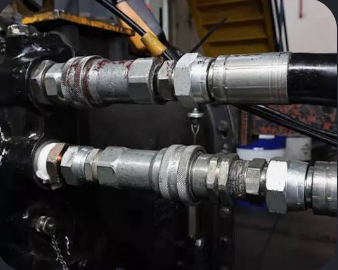
Trapped Pressure: Why Quick-Fix Tools Fail Hydraulic Lines?
The bottom line: do not buy a tool to force a blocked sealing valve open. If trapped pressure is a regular condition in your hydraulic circuit, the quick coupling is the wrong component for the application. A simple web search easily finds devices that retract a sealing valve, or join two halves, while pressure remains trapped in the line; they are neither very cheap nor too expensive, look easy to use, and tempt anyone who connects hydraulic lines more or less frequently. A slightly more in-depth analysis immediately shows the disadvantages, or risks, far outweigh the benefits. The most convenient choice is a quick coupling designed to be connected under residual pressure, with an integrated pressure relief system. Tools belong to emergencies, not to routine work.
Key Takeaways
- Trapped pressure pins the sealing (poppet) valve to its seat. Forcing it back is like opening a blocked lock without the key; the key is the pressure relief system.
- Two tool families exist: wing-nut retractors that bleed before connecting, and lever-driven clamp jaws that relieve and connect as simultaneous effects.
- The real cost is not the purchase price: oil splashed on the operator, repeated small spills, collapsed seals and internals, replacement of the entire coupling, and machinery downtime.
- For ISO-A and ISO-B, a poppet equipped with an additional micro-valve, such as the 275 series, connects with minimum or no extra effort and a small volume of oil spilled out.
- If residual pressure is the norm, upgrade to 278 AND 279series, or blocks with cartridges, depending on the application.
A tool supplies force. A correctly specified coupling supplies a relief path. One removes the symptom for a single shift; the other removes the condition for the life of the machine. That distinction decides safety, lifecycle cost and uptime.
Why Trapped Pressure Becomes a Specification Decision
Anyone who connects hydraulic lines more or less frequently has met the problem: a machine is stopped, an implement is swapped, a hose is reconnected after service, and the two halves simply will not go together. The circuit still holds pressure from a held load, thermal expansion, a closed check valve, or a depressurisation step that was missed. Buying one device feels cheaper than auditing every coupling on every machine, and Ehhydraulic than explaining to procurement why a coupling with integrated relief costs more than a standard ISO-A or ISO-B product. Across a global fleet, that shortcut spreads quickly.
The decision is not which tool to order, but which coupling to specify and when a tool is defensible at all. Frequency is the deciding signal: an exceptional event may justify an exceptional measure, while a pattern justifies a component change. Everything below expands that single verdict into mechanism, failure modes, cost structure and a practical specification path for international buyers.
The Verdict: A Tool Is Not a Pressure Relief System
Acting to retract the valve of a quick coupling when it is blocked by pressure is like trying to open a blocked lock without having the key. The key is the pressure relief system. A tool applies mechanical advantage; it does not create a controlled path for the retained fluid. The valve yields, the halves connect and the job gets done today, but the pressure differential that should have been removed by decompression is instead absorbed by the valve, the seals and the coupling body.
One cannot think of using a quick coupling not suitable for a certain application and of making up for its technological gaps by relying on a tool that mechanically forces internal components to perform movements under conditions in which the quick coupling was not designed to work. Proper solutions are out there, to make the operator's life easier and safer. They replace the workaround rather than refine it.
What Trapped Pressure Does Inside the Coupling
In the disconnected state the poppet or sealing valve is held on its seat, preventing fluid loss and keeping contamination out. During a normal connection the valve of each half is displaced by the valve of its counterpart: a balanced, low-force, designed movement that opens both flow paths together. That mutual displacement is the whole basis of a standard quick coupling.
Retained pressure destroys the balance. It adds to the seating load, so the connecting force rises sharply and the sleeve stalls. If an external lever persists, the valve is finally driven back while the compressed fluid escapes abruptly, at the exact moment the seal is most vulnerable. Degradation is cumulative rather than dramatic: after a certain number of cycles seals or other internal components collapse, and the practical remedy becomes frequent, more expensive replacement of the entire quick coupling rather than a seal kit. By the time leaks or stiff engagement appear, the damage is already internal.
The Two Tool Families, and Where Each One Breaks Down
Both concepts achieve a connection. Neither removes the underlying condition, and their risks differ in ways that matter to operators, safety managers and buyers.
1. Wing-nut valve retractors: bleed first, connect second
One kind of tool allows the sealing valve to be moved back and the pressure to be released by turning a wing nut which presses against the valve itself. Fairly, this concept has a low probability of damaging or wearing out the quick coupling, because the valve is retracted in a relatively slow, controllable way before the halves are joined. That advantage is real and it is the reason these tools keep selling.
The exposure is human and procedural. Operators using them improperly can get splashed with hydraulic oil, at the point where hands and face are closest to the coupling. Even though the amount of oil spilled outside is not generally that big, using this type of tool frequently to release pressure before being able to connect is definitely an inefficient and non-ecological action: every connection gains an extra step, a spill, a wipe-down and a waste stream. It also hides the specification error, so the workaround quietly becomes standard practice and new operators are trained to depend on it.
2. Lever-driven clamp-jaw tools: connect and bleed at once
There is another concept of tool, designed to make the valve of a quick coupling retract as a result of the thrust exerted by the valve of the counterpart: in this case pressure relief and quick coupling connection are simultaneous effects. This type of tool is equipped with clamp jaws which get closer and closer by means of a lever mechanism. Each jaw holds one quick coupling half, therefore the progressive approach of the jaws ends when the two halves get connected.
That simultaneity is the weakness. There is no controlled bleed window: decompression, valve stroke and seal engagement all happen together at maximum mechanical advantage. The full seating load is overcome by the lever rather than removed by a relief path, repeatedly, by the seals and internal components. This is precisely the pattern that ends in frequent, more expensive replacements of the entire quick coupling, not to mention the high costs caused by machinery downtime.
| Decision factor | Tool-based workaround | Integrated pressure relief coupling |
|---|---|---|
| Where pressure is released | At the valve face, under external force, during a manual operation | Through a designed relief path inside the coupling |
| Effort to connect | Extra tool setup, extra step, extra force | Minimum or no extra effort under the same conditions |
| Oil released | Repeated small spills on every connection | Small volume of oil spilled out, from a tiny controlled chamber |
| Wear pattern | Cumulative load on seals and internal components | Operation stays within the design envelope |
| Intended use | Emergency procedure only | Routine operation, including frequent connection |
The Hidden Cost Stack: Why "Cheap Enough" Turns Expensive
The purchase price is visible and finite. Everything it generates is distributed, delayed and easy to omit from a comparison. For a global customer, where machines may be thousands of kilometres from the nearest spare part, the balance is even less favourable.
- Personal exposure. A hydraulic oil splash means an immediate stop, a cleanup and a slip hazard around the machine, close to an uncontrolled release.
- Fluid and environment. A single modest spill becomes lost oil, absorbents, disposal and a non-ecological routine when repeated on every shift.
- Component life. After a certain number of forced cycles seals or other internal components collapse, and the whole quick coupling is replaced more often and at higher cost.
- Machinery downtime. The high costs of a stopped machine usually outweigh the parts, and in remote or export markets add lead time, travel and expedited freight.
- Process inefficiency. An extra step, a tool to track, a technique to train and a deviation from the intended operating method on every connection.
- Deferred decision. As long as the tool works nobody re-specifies the coupling, so the fleet keeps paying for a mismatch that one component change would remove.
The Right Fix: Couplings Designed for Trapped Pressure
With regard to ISO-A and ISO-B series of quick couplings, choosing instead a version where the poppet valve is equipped with an additional micro-valve looks by far a better solution; Ehhydraulic's 275 series are examples of this architecture. Relieving pressure from the tiny volume behind the micro-valve is extremely easy, and that action is enough to decompress the whole system.
Once that small chamber is depressurised, the differential pinning the main poppet to its seat disappears and the normal connecting motion works again. These couplings can be connected with a minimum or no extra effort, and with a small volume of oil spilled out, in the same conditions where this manoeuvre reveals practically impossible with a standard product. The difference is in kind, not just in degree: a controlled micro-volume released by design, instead of a habitual bleed-and-wipe routine. It is cleaner, easier to document across international sites, and keeps the seal inside its design envelope.
When to Replace Instead of Retrofit
The trigger is behavioural, not technical. If an operator realises that most of the times he needs to connect a quick coupling there is pressure trapped into the circuit, and that the quick coupling is not designed for this type of operation, he should replace it with a product having appropriate characteristics.
Depending on the applications, Ehhydraulic's278 and 279series, as well as blocks with cartridges, are all valid options. They answer the same requirement in different architectures: connect with residual pressure present, without an external device forcing the internals. Match the choice to the series, the circuit and the connection frequency rather than assuming a like-for-like substitution.
- Confirm the pattern. Log how often connection is attempted while the line is still pressurised.
- Identify the interface. Establish whether a micro-valve poppet version fits the installed ISO-A or ISO-B footprint.
- Choose the architecture. Consider a micro-valve poppet version, a purpose-built series, or blocks with cartridges at manifold level.
- Plan the changeover. Replace both halves where required, update the parts list, and retire the workaround tool so it cannot re-enter the procedure.
Emergency Use Only
This may be considered an emergency procedure but not a routine operation. A stranded machine or a one-off recovery is a different decision from equipping every technician with a workaround. If such a use is unavoidable, treat the event as an inspection trigger: check for leaks and for any change in how the halves engage, and schedule a specification review as the follow-up action. Do not let the exception become the standard, because after a certain number of times the seals or other internal components will collapse, and the eventual bill will include both the coupling and the downtime.
A Practical Decision Checklist
- Is trapped pressure present on most connections, or only rarely? If most, specify a new coupling.
- Is the installed coupling designed to be connected under residual pressure? If not, no tool makes it so.
- Have operators been splashed with hydraulic oil during a bleed? Treat that as a process warning.
- Are small oil spills wiped up as a normal part of every connection? Count them as recurring cost.
- Is the same coupling being replaced more often than comparable units elsewhere on the machine?
- Has total cost, including machinery downtime and spare-part logistics, been compared with a correct coupling?
Frequently Asked Questions
Can a valve-retraction tool damage the quick coupling?
Wing-nut retractors have a low probability of damaging or wearing out the coupling, but they expose the operator to oil and add an inefficient, non-ecological step. Clamp-jaw tools repeatedly load seals and internals; after a certain number of cycles those parts collapse and the entire quick coupling needs replacing.
If the oil spill is small, why change the component?
Single events are small, repetition is not. Frequent bleeding means lost fluid, cleanup and disposal every time, and the spill is only a symptom of a valve being loaded outside its design envelope.
Why not specify a heavier-duty standard coupling?
The problem is not insufficient strength, it is the absence of a pressure relief path. The key is the relief system, whether a micro-valve on the poppet or a purpose-built coupling designed for connection under trapped pressure.
When should a fleet upgrade?
When residual pressure is the normal state at connection time rather than an occasional surprise. At that point the tool has become routine, and the choice is between a planned component change and unplanned replacements plus machinery downtime.
Specify the Relief, Not the Workaround
Avoid the risks associated with retracting sealing valves using tools; opt for our quick couplings with integrated pressure relief systems. Our team is here to guide you and offer tailored solutions to fit your needs. Share the series, the circuit conditions and how often you connect, and we will help you choose the coupling that removes trapped pressure from the equation instead of forcing a valve to tolerate it.